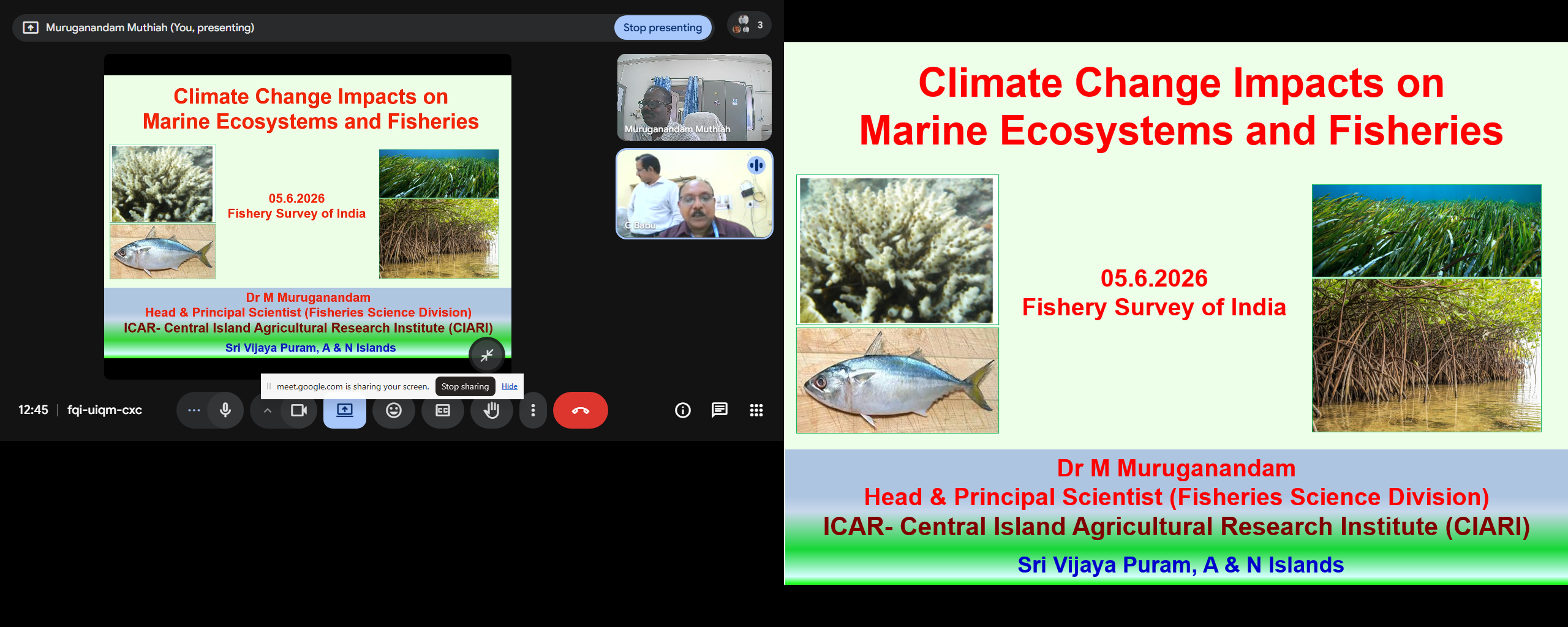

As part of World Environment Day observances, the Fishery Survey of India (FSI), in
association with ICAR-Central Island Agricultural Research Institute (ICAR-CIARI), National
Institute of Ocean Technology (NIOT), NGOs, fishermen, college students, and community
members, organized an awareness programme on climate change and marine fisheries at FSI, Sri
Vijaya Puram, Andaman & Nicobar Islands.
Delivering the keynote lecture online, Dr. M. Muruganandam, Principal Scientist and Head,
Fisheries Science Division, ICAR-CIARI, highlighted the growing evidence of climate change
impacts on oceans and fisheries resources across India and the world.
Dr. Muruganandam explained how the vast ocean surface absorbs a significant share of global
climate impacts, resulting in rising sea temperatures, sea-level rise, altered ocean circulation
patterns, ocean acidification, and increased frequency of extreme weather events. He elaborated
on the cascading effects of these changes on fish growth, spawning and reproduction, migration
patterns, predator-prey relationships, survival rates, biodiversity and species composition,
fisheries productivity, and the economics of fishing communities.
Particular emphasis was placed on the vulnerability of coral reef ecosystems, seagrass meadows,
mangrove forests, and other coastal habitats, which serve as critical breeding and nursery
grounds for marine organisms. The degradation of these ecosystems, he noted, threatens both
biodiversity conservation and long-term fisheries sustainability.
Drawing from field observations and interactions with fishing communities, Dr. Muruganandam
pointed out that climate change impacts are increasingly visible at the grassroots level.
Fishermen have reported noticeable shifts in fish availability and stock structure, including
instances where mature and harvestable fish stocks are more abundant during fishing ban
periods, while greater numbers of juveniles and broodstock are encountered during active fishing
seasons. Such changing patterns, he suggested, warrant a scientific reassessment of fishing
holiday schedules and fisheries management strategies based on contemporary stock dynamics
and biomass assessments.
He urged participants to recognize the role of individual and collective actions in mitigating
climate change and emphasized that environmental considerations must be integrated into
policies, technologies, and production systems. Sustainable development, he noted, requires
balancing economic growth with environmental stewardship to ensure the resilience of fisheries
and coastal livelihoods.
Earlier, Shri Balanayak, Marine Mechanical Engineer, FSI, welcomed the participants and
stressed the importance of collaborative action for environmental conservation. Dr. C. Babu,
Fisheries Scientist, FSI, highlighted the critical linkages between environmental health, ocean
ecosystems, and fisheries production.
The programme was attended by around 40 participants, including professionals from NIOT,
representatives of non-governmental organizations, students from Pondicherry University,
fishermen, and other stakeholders. The event concluded with an interactive question-and-answer
session, during which participants discussed their concerns and sought clarifications on climate
change impacts, marine ecosystems, and the future prospects of fisheries resources under
changing environmental conditions.