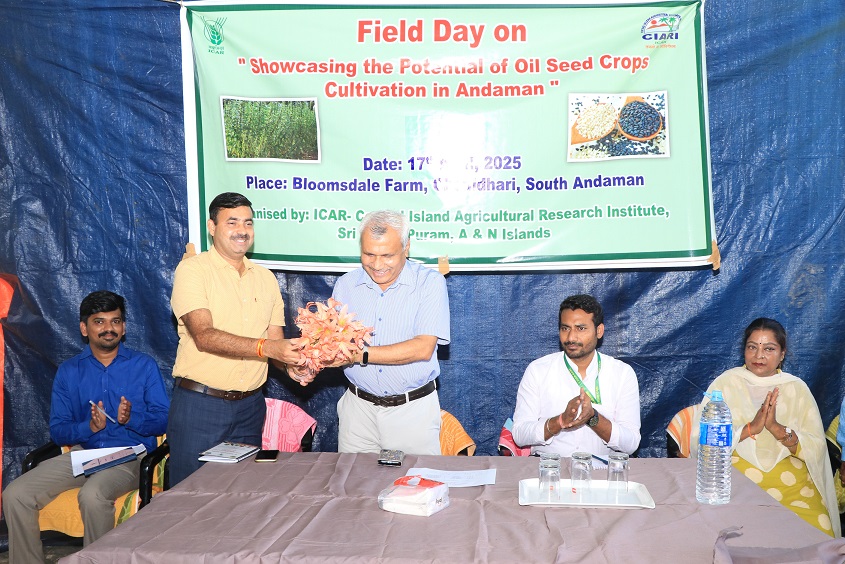

A Field Day was organized on April 17, 2025, at the Bloomsdale Research Farm of ICAR–Central Island Agricultural Research Institute (CIARI) to highlight the potential of oilseed crop cultivation in the Andaman Islands. The event was conducted in collaboration with ICAR-Krishi Vigyan Kendra (KVK), South Andaman, and KVK, Nimbudera, North and Middle Andaman with the goal of promoting oilseed cultivation among island farmers to diversify crops and reduce reliance on monoculture farming systems.
The Field Day featured live demonstrations of various oilseed crops, including sesame, sunflower, safflower, castor, and linseed. Over 40 different oilseed varieties were showcased, offering valuable insights into their cultivation, performance, and suitability under island conditions.
SFarmers were briefed on the varietal characteristics, climatic requirements, and best practices for cultivating these crops. Dr. E. B. Chakurkar, Director of ICAR–CIARI, addressed the gathering, emphasizing the importance of crop diversification and the risks associated with monoculture systems. He stressed the benefits of integrating drought-tolerant oilseed crops to increase self-sufficiency and resilience in the region's agricultural landscape.
Dr. P. K. Singh, In-Charge of the Field Crop Improvement and Protection Section highlighted the economic potential of cultivating oilseeds on rice fallow lands, which are abundant in the Andaman region, especially following the paddy harvest. Dr. Prabhu, Scientist, explained the process of varietal selection and recommended practices suited to island conditions, helping farmers understand how to adapt these crops to local environmental factors.
The event sparked significant interest among the 30+ participating farmers from South, North, and Middle Andaman, who actively engaged with experts by asking questions on topics such as agronomy, seed availability, and market prospects. Officials from the Department of Agriculture Smt. Beena, Circle Officer and Nasir, In-charge Seed Production farm, Chouldari also attended, contributing to the event’s success.
Overall, the Field Day proved to be an effective platform for raising awareness and enhancing the capacity of island farmers, with the aim of promoting sustainable agricultural practices and improving nutritional security through oilseed crop diversification.